 Latchly
Wet Diapers Newborn: 7 Signs Your Baby Is Fine
It’s 3am and you’re peeling open a diaper with your phone flashlight, trying to decide if it counts. The outer layer looks dry. The inner lining feels soft, not swampy. You’re not sure if baby has peed once in the last 4 hours or four times. And every post you’ve read says “count wet diapers” as if it’s the simplest thing in the world.
It’s not. Modern newborn diapers are engineered to pull moisture away from the skin so fast that a “wet” diaper can feel almost dry 10 seconds after the pee happens. Add exhaustion and dim light and you’re basically guessing. That’s why you’re counting wrong and panicking about it.
Here’s the short version. By day 5 you want 6 or more wet diapers in 24 hours. Before that, output is much lower and that’s normal. And there are a few quick ways to actually tell if a diaper is wet, even when it doesn’t look it. Let’s walk through it.
What “Wet Diapers Newborn” Actually Means
A wet diaper means your baby has peed into the diaper at some point since you last put a fresh one on. That’s it. It doesn’t have to be soaked. It doesn’t have to be heavy. Even a small amount of urine counts as one wet diaper, especially in the first week when baby’s bladder is tiny.

A few brands (Pampers Swaddlers, Huggies Little Snugglers, Honest Company, and most others aimed at newborns) print a wetness indicator on the outside: a thin yellow line that turns blue or bluish-green when it touches urine. That’s the single easiest check. If the line has any color change, the diaper counts.
If your brand doesn’t have the indicator, the two backup tricks are:
- The heft test. A wet diaper feels heavier and has a slightly puffier crotch. Pick up a fresh unused one, feel the weight, then pick up the diaper you’re checking. You’ll notice the difference within a day of practice.
- The tissue trick. Tuck a quarter-sheet of plain tissue or paper towel between the diaper and baby’s skin at the start of a feed. When you change the diaper, check the tissue. Urine shows up immediately.
Save this for later on Pinterest
Tap any design below to save it to your Pinterest board. Come back when you need it at 3 a.m.


Why Counting Wet Diapers Matters So Much
Wet diapers are the single most reliable way to tell if your newborn is getting enough milk. You can’t see inside your body. You can’t measure what went in at the breast. But you can absolutely measure what comes out the other end.
Enough pee means enough milk. Urine is mostly water, and the water came from the milk your baby drank. If baby is making pale, regular pee, they’re hydrated. If they’re hydrated, they’re almost certainly fed. The 7 signs your breastfed baby is getting enough milk article covers the rest of the picture, but wet diapers do most of the work.
The second reason counting matters: kidney output is one of the earliest signs if something is actually wrong. A baby who suddenly stops peeing is in a different category from a baby who’s feeding a bit less than yesterday. Pediatricians ask about wet diapers at every early well visit because it’s that useful.
Wet Diapers by Day: The Newborn Chart
Here’s what’s normal by age. These counts are for any newborn, breastfed or formula-fed, in the first 6 weeks.
Day 1 (0-24 hours after birth): 1 wet diaper. Baby has only been drinking teaspoons of colostrum and their kidneys just started working in air. One pee in the whole first day is completely fine.
Day 2: 2 wet diapers. Still low. Colostrum is thick and concentrated and baby isn’t getting huge volumes yet. Don’t panic.
Day 3: 3 wet diapers. Your milk is probably coming in around now, or about to. Output starts to climb.
Day 4: 4 wet diapers. By the end of day 4, most moms have seen their milk transition from colostrum to mature milk. Wet diapers respond the same day, usually jumping noticeably.
Day 5 onward: 6 or more wet diapers in 24 hours. This is the steady-state number. Every day from day 5 through the rest of the newborn period, you want at least 6. Many babies will do 8-10+. Both are fine.
Weeks 2-6: still 6+ wet diapers a day. The number can fluctuate (5 one day, 9 the next) but should stay above 6 as a daily average. Pale yellow or almost-clear urine is what you want to see.
Month 2 and beyond: 5-6+ wet diapers a day. Some babies start to pee in bigger batches less often. 5 soaked diapers can be equivalent to 6 smaller ones. Trust the volume and the color.
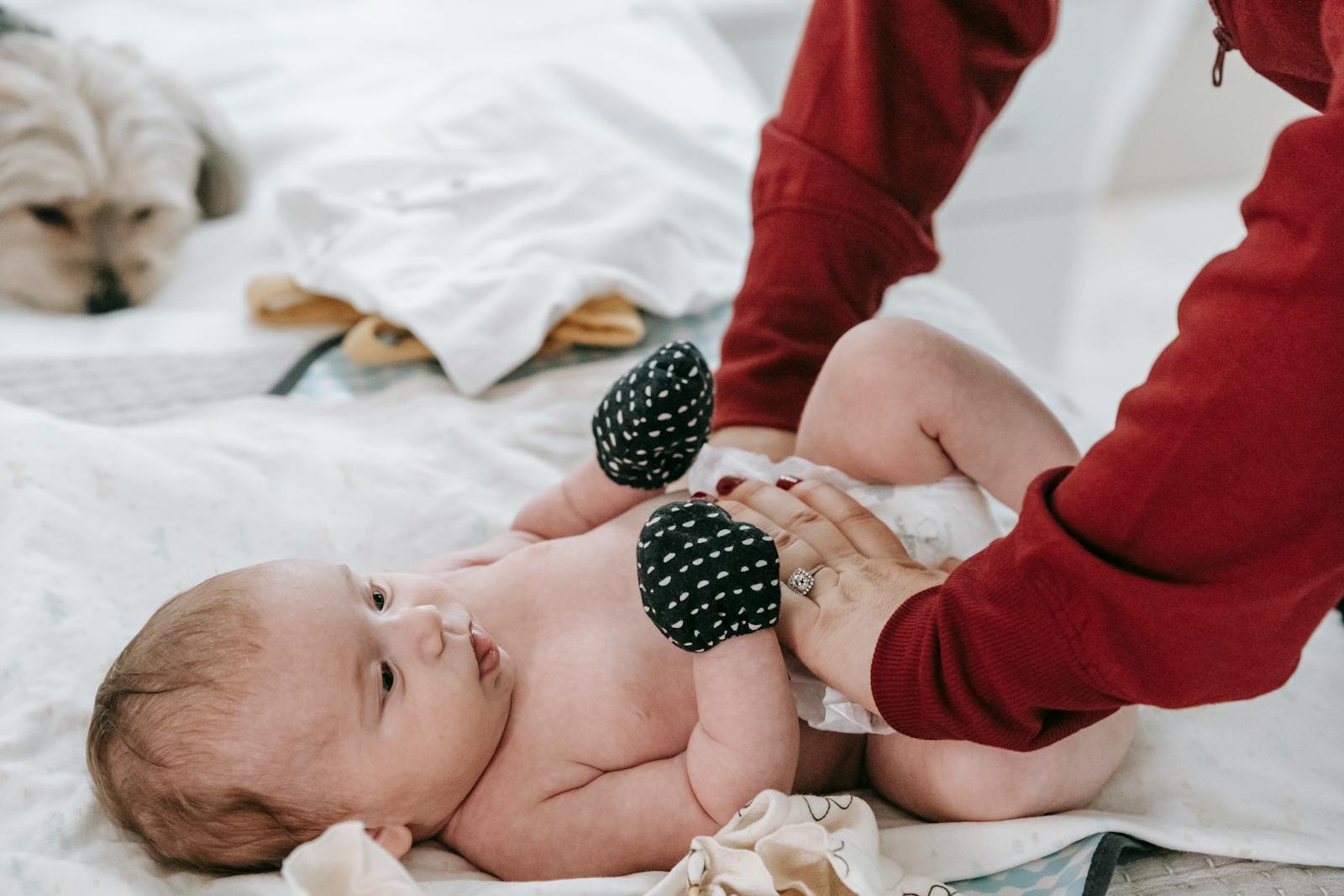
A simple way to hold the chart in your head: the day number is the minimum count until day 5, then it’s 6+ every day after.
7 Signs Your Baby Is Fine (Not Just the Count)
Don’t rely on one number alone. Here are the 7 signs that tell you, together, that your baby is hydrated and fed.
1. 6+ wet diapers a day after day 5. The core metric. Count across 24 hours, not per feed.
2. Pale yellow or nearly clear urine. If the wetness indicator line is bright yellow on the outside of the diaper, or if the pee spot looks clear, baby is well hydrated. Dark yellow is borderline and worth another feed. Orange is too concentrated.
3. No pink or brick-red stains after day 4. In the first 3-4 days, some babies pass urate crystals (pink or reddish-brick dust in the diaper) as their kidneys adjust. It’s normal early on. After day 4, it usually means baby needs more fluid, and that means more feeding.
4. At least 3 seedy yellow poops a day after day 5. Poop output confirms milk is moving through. Mustard-yellow with tiny white seeds is the classic breastfed-baby color. Formula-fed poops are pastier and more tan.
5. Baby wakes on their own to feed. Alert enough to root, cry, or fuss for a feed 8-12 times in 24 hours. A baby who sleeps through feed windows for long stretches and is hard to rouse is different from a normally sleepy newborn.
6. Steady weight gain at well visits. Newborns lose up to 7-10% of birth weight in the first few days, then regain it by day 10-14. After that, expect 4-7 ounces a week for the first 4 months.
7. A soft, flat (not sunken) soft spot. The fontanelle on the top of baby’s head should feel level with the rest of the skull. If it looks sunken or caved-in, that’s a dehydration flag. This one you can check with a finger any time.
If 5 out of 7 are solid, your baby is doing fine. If most of them are missing, call the pediatrician the same day.
Why Modern Diapers Make Counting So Hard
Ultra-absorbent diapers were designed to keep baby’s skin dry, and they do that incredibly well. The downside is they also keep YOU from being able to tell there’s urine in there without looking closely. Moms 20 years ago saw a puffy, obvious wet diaper every change. You don’t.
This is the #1 reason new moms think their baby isn’t peeing enough when they actually are. Use the indicator line, the heft test, or the tissue trick. Trust the method, not your gut. The pee happened.
For cluster feeding evenings, where baby is glued to your chest for hours, you’ll sometimes go 3-4 hours without a diaper change and worry the whole time that baby isn’t peeing. They usually are. The diaper just isn’t bulging about it.
How Wet Diaper Counts Change Week by Week
Expect the count to be highest in weeks 2-4 and then gradually shift. By the end of the first month, many babies are peeing a bit less often but in bigger volumes per diaper. So 6 heavier diapers a day at 5 weeks can mean the same thing as 10 light ones at 10 days old.
What you’re really measuring is total urine output, not the count on its own. A soaked, heavy diaper is worth more than a barely-damp one. If you start seeing big, heavy wets a few times a day, that’s normal and healthy even if the total count drops slightly.
When to Call Your Pediatrician
Call the same day if you see any of these:
- Fewer than 6 wet diapers in 24 hours after day 5.
- Dark orange or brown urine at any age past day 3.
- Pink or brick-red stains in the diaper after day 4.
- A sunken soft spot on top of baby’s head.
- Dry lips, tacky mouth, or no tears when crying hard.
- Hard to rouse for feeds, or sleeping through multiple feed windows in a row.
- No wet diaper for 8 hours straight at any age past day 2.
Call sooner (not same-day, but now) if baby is also showing signs of illness: fever over 100.4°F rectally, rapid breathing, vomiting repeatedly, or looking gray or mottled. Newborn dehydration can get serious fast, and pediatricians would much rather hear from you early than late.
The Thing I Wish I’d Known
Nobody warns you how much mental bandwidth diaper-counting would take. You’ll keep a tally on your phone, your partner will ask “when was the last one?” like it’s a security code, and you’ll wake up at 3am wondering if that weird damp-but-not-wet one from midnight even counted.
Here’s what I wish someone had said: your baby is usually telling you the truth through the diaper. If the count is hitting 6+ and the urine is pale, they’re good. You don’t have to weigh them, pump to measure ounces, or interrogate every feed.
You’re allowed to use the indicator line. You’re allowed to stop counting at 6 and call it done for the day. You’re allowed to sleep the 40 minutes you could be spending squinting at a wet-but-technically-dry diaper.
Check the diaper, check the color, trust the math. Then put the baby down and take a breath. Over on the first 14 days of breastfeeding we walk through the whole two-week ramp-up alongside these counts, because the wet diaper story doesn’t happen in isolation. It happens on 3 hours of sleep, while milk is coming in, while your body is still sore, while you are doing the single hardest thing you’ve ever done.
You’re not failing. You’re counting. And you’re doing it right.